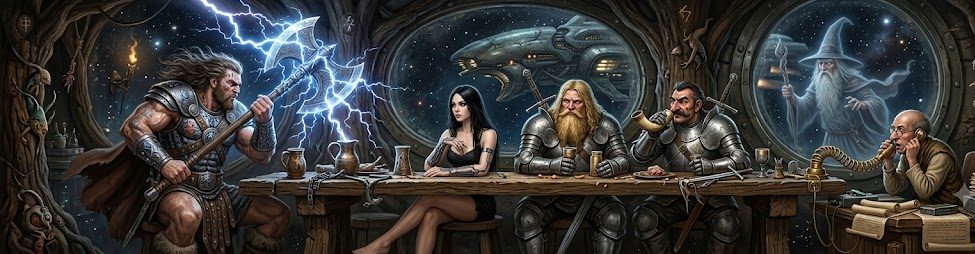
Sooner or later, every fantasy writer hits the moment where a character needs a name. You can go the classic route, Aldric, Seraphina, Thorne, and nobody blinks. Or you can open the website of a heating appliance manufacturer or an eyewear company and find the nobility that fantasy truly deserves.
I chose the second option. Here’s why.
All of them show up in my novel Heroic Adventures of Junker’s and Vailiant, which might be the first book title in history that also doubles as a plumbing supply order.
Knights Who Are Secretly Water Heaters
My knights are named Junkers and Vaillant. Sounds dignified, doesn’t it? Almost like some old Germanic-French noble bloodline out of a saga.
Well, it is, just not quite in the way you’d think.
Junkers, besides being a well-known boiler brand today, was historically the term for the landed Prussian nobility. So the name I gave my knight literally means “nobleman with an estate”, which fits a knight perfectly. Except any German reader will first picture the appliance quietly heating water in the basement.
Vaillant is even better, because no translation is even needed, in French it literally means brave. A knight named “The Brave One.” Except it also happens to be a boiler brand. So we’ve got a knight whose name simultaneously means “valiant hero” and “the box in the corner of the kitchen quietly doing its job.” I honestly can’t decide if that’s a coincidence or destiny.
Wizards Who Are Secretly Selling You Glasses
For the wizards, I went into the optics industry: Zeiss and Rodenstock.
The logic here is admittedly a bit cheeky, a wizard is a character who “sees” what others can’t: the future, the truth behind an illusion, the things that are hidden. So naturally I named him after a company that literally makes lenses for sharper vision. Zeiss sharpens your image; my Zeiss sharpens reality. Same job, minus the copay for the eye exam.
Rodenstock is on the list purely for aesthetic reasons, it sounds like an old noble surname from Central Europe, when in fact it’s an eyewear chain. If any reader happens to wear that brand of glasses, they now know they’re reading the name of their own personal wizard every time they look in the mirror.
The Ladies Who Aren’t Quite What They Sound Like
And then there are the women in the story: Calvitia and Anelida.
They sound like they walked straight out of an elegant Latin family tree, don’t they? Calvitia, faintly imperial, almost Roman. Anelida, soft, poetic, almost fairy-like.
Calvitia comes from the Latin calvities, meaning baldness.
Anelida is, phonetically, suspiciously close to Annelida, the phylum of segmented worms, which includes earthworms and leeches.
So somewhere in my book, two dignified-sounding ladies are wandering around with names that, once you break them down, mean “Baldy” and “Wormy.” None of the characters know this. Neither did the readers, until now.
Why I’m Even Doing This to Myself
Honestly? Because nobody will ever notice, and I get to quietly laugh to myself every single time I write a scene with them in it. It’s the kind of joke that exists purely for the author, until, apparently, the author decides to write a blog post about it.
If you’ve already read the book and thought the names sounded “oddly familiar,” now you know why. And if you haven’t, maybe this is a good reason to start hunting for more hidden jokes. There are more of them. I’m not telling you where.
If you want to meet Junkers, Vaillant, Zeiss, Rodenstock, Calvitia, and Anelida in person, they’re all waiting for you in Heroic Adventures of Junker’s and Vailiant, grab it on Amazon or Goodreads, or find it on my website.